Salt does not just make food salty.
Remove salt entirely from a well-seasoned dish and something odd happens. It does not simply taste ‘less salty.’ The sweetness becomes muted. The acidity loses its edge. The savoury depth — the umami — goes quiet. What you are left with is flat, one-dimensional, somehow less of itself.
Salt is a flavour amplifier. It suppresses bitterness (which otherwise masks other flavours) and enhances the perception of almost everything else. This is why a pinch of salt in chocolate or caramel is not a trick — it is chemistry.
But when you add it matters as much as how much you add.
What salt actually does
Salt has several distinct functions depending on when and where it is applied:
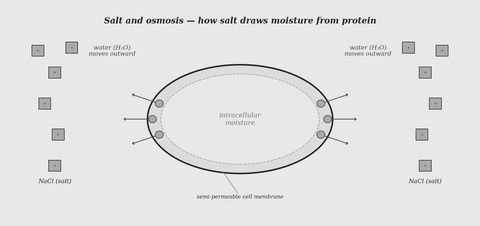
On raw protein (osmosis): Salt draws moisture out of the surface of meat or fish via osmosis — water moves across the cell membrane toward the higher concentration of salt on the surface. That moisture dissolves the salt, creating a small amount of brine. Given enough time (at least one hour, ideally overnight), that brine is reabsorbed back into the muscle, carrying the salt deep into the protein. The result is meat that is seasoned throughout, not just on the surface. The surface also dries out as water is drawn away — which, as a secondary effect, promotes better browning when the meat hits the pan.
This is dry-brining. It costs you nothing but time, and the difference is significant.
On vegetables: Salt draws water out of cut vegetables, concentrating flavour and — in some cases — changing texture. Salted cucumber releases its moisture and becomes more pliable. Salted eggplant loses bitterness as phenolic compounds dissolve in the drawn-out water. Salted cabbage softens for coleslaws. Apply it, wait, then rinse or press depending on the recipe.
In pasta water: Salt in boiling water seasons the pasta from the outside in during cooking — no amount of sauce added afterward can replicate this. The water should taste of the sea, or at least noticeably salty: roughly 7–10 grams per litre. This is not excessive; most does not absorb into the pasta.
In bread dough: Salt strengthens the gluten network and controls yeast fermentation speed. It also dramatically improves flavour — unsalted bread tastes hollow. Add salt after the initial mixing (not directly on top of the yeast if adding both at once — salt deactivates yeast at high concentration).
The seasoning order
The professional kitchen principle: season at every stage, not just at the end.
Salt added during cooking penetrates and integrates. Salt added only at the end sits on the surface. Both are needed. The goal is flavour built through, not sprinkled on top.
A practical sequence:
- Season proteins in advance — dry-brine at least one hour before cooking, overnight for larger cuts.
- Salt the cooking water for pasta, vegetables, and blanching.
- Season sauces and braises early, then adjust at the end — bearing in mind that reduction concentrates salt.
- Finish: a few flakes of fleur de sel or good sea salt on the plate, applied just before serving, adds crunch and a burst of immediate saltiness that makes the first bite interesting.
Wet-brining vs dry-brining
Wet-brining — immersing protein in a salt-water solution (2–5% salt by weight) — causes the muscle proteins to absorb extra water from the brine, making the meat juicier after cooking. It is particularly useful for very lean proteins prone to drying out: chicken breast, pork loin, turkey.
The trade-off: wet-brining dilutes the meat’s own flavour and makes pan juices too salty for sauces. For well-marbled beef and lamb, it is rarely worth it. Dry-brining delivers better flavour and better browning at the cost of a little more planning.
The most common mistakes
| Mistake | What went wrong | How to prevent it |
|---|---|---|
| Food tastes flat even with salt on the plate | Salt added only at the end — never integrated into the dish | Season at every stage: protein in advance, water during cooking, sauce early. |
| Pasta tastes bland despite a good sauce | Pasta water was under-salted or unsalted | Salt the water generously before the pasta goes in — 7g per litre minimum. |
| Steak is salty on the outside, bland inside | Salted immediately before cooking — no time for absorption | Dry-brine at least one hour ahead; overnight is better. |
| Sauce became too salty during reduction | Salt added before reducing — concentration doubles as water evaporates | Add salt lightly before reducing, then adjust to taste at the end. |