The difference between perfect and overcooked is about four degrees.
Most people treat eggs as simple. Boil, fry, scramble. But eggs are one of the most temperature-sensitive ingredients in the kitchen, and understanding what happens to them at different temperatures unlocks a level of control most home cooks have never experienced.
The key: egg yolk and egg white are made of different proteins. They set at different temperatures. And you can target the gap between them.
The science
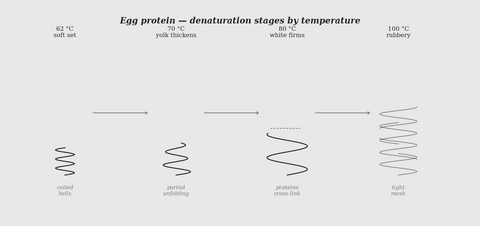
A whole egg is roughly 12% protein suspended in water. When heated, these proteins denature — they unfold and bond together, trapping water and forming a solid gel. But different proteins in the egg denature at different temperatures:
- Egg white (ovotransferrin): begins setting at around 60°C
- Egg white (ovalbumin): sets fully around 80°C
- Egg yolk: begins thickening around 63°C, fully set around 70°C
This is why a “six-minute egg” has a set white and a jammy, semi-liquid yolk. You have targeted the zone where ovalbumin has gelled but the yolk proteins have only partially set. A few degrees higher and the yolk firms completely. A few more and the white turns rubbery — because the proteins have over-contracted and squeezed out the water they were holding.
Overcooked scrambled eggs are not a failure of attention. They are a failure of temperature control.
Boiled eggs: the method
The single most reliable method is to bring a pot of water to a rolling boil, lower the eggs in carefully, and time precisely from the moment they enter the water. Cold eggs from the fridge will lower the water temperature briefly — allow an extra 30 seconds.
| Time in boiling water | Result |
|---|---|
| 5 minutes 30 seconds | Soft white, very runny yolk — dippy egg territory |
| 6 minutes 30 seconds | Fully set white, yolk jammy and bright orange at the centre |
| 8 minutes | Yolk just set through, still moist and creamy |
| 10 minutes | Hard-boiled, yolk fully firm. Beyond this, the grey-green ring around the yolk appears — iron and sulphur reacting at the surface of the yolk. |
After cooking, transfer immediately to ice water. This halts carry-over cooking and makes peeling significantly easier by contracting the egg away from the membrane.
Scrambled eggs: low and slow
The common mistake with scrambled eggs is too much heat, too fast. High heat causes the proteins to bond rapidly and unevenly, producing large, rubbery curds with pockets of expelled water. The result is dry, grainy scramble.
The correct approach: low heat, constant gentle movement, and removing from the heat slightly before they look done. The residual heat in the pan finishes them.
Use a non-stick pan over the lowest heat setting. Add the beaten eggs (seasoned, with a small amount of cold butter stirred in) and move them continuously with a spatula, scraping from the edges inward. When they look barely underdone — still slightly glossy, with large soft curds — remove from the heat and stir for another 30 seconds off the heat. Add a small knob of cold butter at this point to stop the cooking and add richness.
They should take three to four minutes. If they are done in under two, the heat is too high.
Fried eggs: heat management
A properly fried egg has a set white and a yolk that is still fluid — and no brown, crispy edges. The problem: the white takes longer to set than the yolk is willing to wait at high heat.
The solution is to use moderate heat and cover the pan with a lid for the last 30 seconds. The trapped steam gently sets the top of the white without applying direct heat to the yolk. Alternatively, baste the white with hot butter from the pan as it cooks, directing heat to the white while the yolk remains insulated.
The most common mistakes
| Mistake | What went wrong | How to prevent it |
|---|---|---|
| Rubbery scrambled eggs | Proteins over-contracted from high heat, moisture expelled | Low heat, constant movement, pull slightly before done. Residual heat finishes them. |
| Grey-green ring around hard-boiled yolk | Iron (yolk) + sulphur (white) reacting at high temperature | Do not overcook. Transfer to ice water immediately after cooking. |
| Fried egg white still raw around the yolk | White cooks slower than yolk at same temperature | Cover pan briefly with lid — trapped steam sets the top of the white without touching the yolk. |
| Boiled egg impossible to peel | Membrane still attached after cooking | Ice water bath immediately after boiling. Allow to cool fully before peeling. |