By the time it looks done, it is already overdone.
Most home cooks use colour as their guide. A golden-brown crust, a firmness to the touch, a certain smell — and they pull the steak from the pan. The problem: all of those signals are surface events. They tell you nothing about what has happened to the interior. And by the time those cues appear, the inside of your steak may already be five or ten degrees past where it should be.
Temperature tells you everything. Colour tells you almost nothing.
What is actually happening
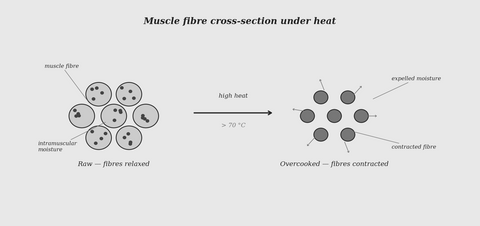
Meat is muscle. Muscle is made of protein fibres — primarily myosin and actin — bundled together and suspended in water. About 75% of raw meat is water. When you apply heat, those proteins begin to denature: they unfold, then bond together, physically contracting and squeezing moisture out of the fibres the way you would wring out a towel.
This process begins around 55°C and accelerates sharply above 65°C. By the time meat reaches 70°C, most of the intramuscular water has been expelled. The result is a steak that is dry, dense, and chewy — not because you bought poor-quality meat, but because you cooked it ten degrees too far.
The internal temperature targets are not suggestions:
- 52°C — rare. Proteins beginning to denature. Still very juicy.
- 57°C — medium-rare. The sweet spot for most beef. Proteins contracted but moisture largely retained.
- 63°C — medium. Noticeably firmer. Some moisture lost.
- 68°C+ — well done. Most moisture expelled. This is dry by physics, not by bad luck.
The tool you actually need
A probe thermometer. Not a rule of thumb. Not a finger press. Not a timer. If you own one piece of kitchen equipment beyond a sharp knife, make it a probe thermometer. Insert it into the thickest part of the steak, away from the bone, and pull when you are 3–4°C below your target. The steak will continue cooking after you remove it from the heat — this is called carry-over cooking, and for a thick steak it can add 3–5°C to the final internal temperature.
Pull early. Rest fully. Cut last.
Why resting is not optional
During cooking, muscle fibres contract and push moisture toward the centre of the meat. If you cut the steak immediately off the heat, that moisture — under pressure — runs straight out onto your board. You will see it pooling there and wonder what went wrong.
Resting allows the fibres to relax slightly and the moisture to redistribute through the meat. For a steak, rest for at least five minutes. For a thick cut — a côte de boeuf, a whole tenderloin — give it fifteen to twenty minutes. Loosely tented with foil to retain warmth, not sealed tight (which traps steam and softens the crust you worked to build).
The practical method
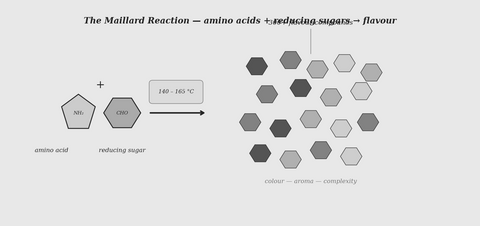
Dry the surface of the steak thoroughly with kitchen paper before it goes in the pan. Moisture on the surface creates steam — and steam prevents the Maillard browning you are trying to achieve. Season generously with salt at least an hour before cooking, ideally overnight — this is dry-brining, and it allows the salt to be drawn into the muscle and reabsorbed, seasoning from within rather than just coating the outside.
Get your pan — ideally cast iron or stainless, not non-stick — very hot before the steak goes in. Not warm. Hot. A drop of water should evaporate in under a second. Add a high-smoke-point oil (refined rapeseed, clarified butter), set the steak down, and do not move it. Leave it alone for two to three minutes until a deep brown crust has formed. Flip once.
Probe. Pull at your target minus 3°C. Rest. Eat.
The most common mistakes — explained as physics
| Mistake | What went wrong | How to prevent it |
|---|---|---|
| Steak is dry and tough | Proteins contracted above 65°C, moisture expelled | Use a probe thermometer. Pull earlier. |
| No crust — pale, steamed-looking | Surface moisture prevented Maillard browning | Dry the surface thoroughly. Pan must be very hot before the steak goes in. |
| Juice runs onto the board when cut | Meat cut too soon — fibres still contracted, moisture pooled in centre | Rest for at least 5 minutes before cutting. |
| Uneven doneness — overdone edge, raw centre | Steak too cold from the fridge — outside overcooked before centre reached temperature | Bring steak to room temperature for 30–45 minutes before cooking. |