Here is a paradox: the cheapest, toughest cuts of meat produce the richest, most deeply flavoured dishes. Beef shin outperforms fillet in a braise. Pork shoulder beats loin in a slow cook. The science behind this is collagen — and understanding it is worth more than any recipe.
Why Tough Cuts Are Tough
Muscles that do a lot of work during the animal's life — the legs, shoulders, cheeks, neck — contain more connective tissue than muscles that rest (the loin, tenderloin). That connective tissue is primarily collagen: a strong, rope-like protein that holds muscle fibres together in sheaths and surrounds them in intramuscular sheets.
When you apply high heat quickly — grilling, searing at high temperature — collagen seizes and contracts, squeezing the muscle fibres and making the meat tough and chewy. This is why you can't grill a shin. But at sustained low heat over time, something different happens entirely.
The Science: Collagen Converts to Gelatin
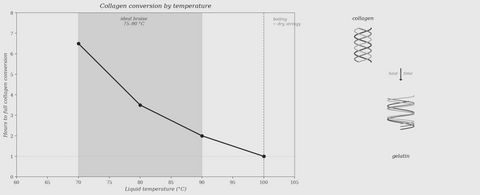
Above 70°C, collagen begins to denature. The triple-helix protein structure — three protein strands wound tightly together — starts to unwind. With sustained heat and the presence of water, those unwound strands dissolve into the braising liquid as gelatin.
This conversion is the entire mechanism of braising:
- The connective tissue holding muscle fibres together dissolves away
- The muscle fibres, now without their collagen sheathing, can be pulled apart with a fork
- The gelatin released into the braising liquid gives it body — the sauce becomes glossy, rich, and coating
- The internal fat (marbling) renders slowly, basting the meat from within
The result is fundamentally different from other cooking methods. Braised meat is tender not because it's rare — the internal temperature is well above well-done — but because the structural proteins that made it tough have been chemically converted into something soft.
Temperature and Time
Collagen conversion is a function of both temperature and time. Higher temperature accelerates the conversion but risks drying out the muscle fibres (which are fully contracted well above 70°C). Lower temperature slows the conversion but is gentler on the meat.
The ideal braise runs at 80–90°C in the liquid — which corresponds to an oven temperature of around 150–160°C, not the 180°C many recipes specify. A rolling boil is destructive: it agitates the meat, breaks apart muscle fibres prematurely, and produces a dry, stringy result despite hours of cooking.
| Liquid temperature | What happens |
|---|---|
| Below 70°C | Collagen barely converts; meat stays tough regardless of time |
| 70–85°C | Slow, steady conversion; ideal for most braises (4–6 hrs) |
| 85–95°C | Faster conversion; good for shorter braises (2–3 hrs) |
| 100°C (boiling) | Rapid conversion but muscle fibres dry and tear; avoid |
The Method
Before you start: Meat should be at room temperature. Braising liquid should be prepared: good stock, wine, aromatics. The vessel matters — use a heavy-based casserole (cast iron or enamelled cast iron) that holds heat evenly.
Step 1 — Sear the meat hard and dry
Pat the meat completely dry. Sear in batches in very hot fat until deeply browned on all surfaces. Do not crowd the pan.
Science note: The sear is not about sealing in juices — that is a myth. It is about Maillard reaction: browning proteins and sugars on the surface to create hundreds of flavour compounds that will dissolve into the braising liquid. A pale braise is a flat braise.
Step 2 — Build the braising liquid
Soften aromatics in the same pan. Deglaze with wine. Add stock until the liquid comes one-third to halfway up the meat, not covering it.
Science note: Covering the meat fully creates steam cooking, not braising. Half-submerged meat braises on the bottom and steams on top, creating texture contrast. The exposed top surface also continues to roast, adding more Maillard flavour.
Step 3 — Cook at a bare simmer, covered, in the oven
Set the oven to 150–160°C. The liquid should show the occasional bubble at the surface, not a boil. Check every hour.
Science note: The oven distributes heat evenly from all directions; the stovetop heats only from below, creating hot spots and uneven conversion. Even heat produces even tenderness.
Step 4 — Test, rest, and reduce
The meat is done when it yields to a probe with no resistance — not when it's falling apart. Remove the meat, rest it, and reduce the braising liquid on the stovetop to a glossy sauce.
Science note: Reduction concentrates the gelatin dissolved from the collagen, and the dissolved Maillard compounds from the sear. The resulting sauce has body (from gelatin), depth (from the browned fond), and richness (from rendered fat). This is what makes braising liquid different from every other sauce.
Common Mistakes — Explained as Science
| Mistake | What went wrong | How to fix it |
|---|---|---|
| Meat is dry and stringy despite hours of cooking | Liquid boiled instead of simmered; muscle fibres tore before collagen fully converted | Lower the oven to 150°C; liquid should barely move |
| Sauce is thin and watery | Too much liquid; insufficient reduction; cut didn't have enough collagen | Remove meat, reduce sauce by half; use collagen-rich cuts (shin, cheek, oxtail) |
| Meat is tough after 3 hours | Temperature too low; collagen conversion incomplete | The cut needs more time; return to oven — collagen conversion is time-dependent |
| Bland braising liquid | Meat not seared, or seared wet (no browning); poor-quality stock | Sear properly — deep brown, not grey; use real stock, not water or cubes |
Chef's Note
The best braises improve overnight. Refrigerate the meat in its liquid after cooking. The fat solidifies on top and lifts off cleanly. Reheat gently — 30 minutes at 140°C in the oven, covered. The gelatin that set during refrigeration melts back into the sauce and the flavours, given 12+ hours to equilibrate, are measurably more complex than straight from the pot. Braise a day ahead, always.